
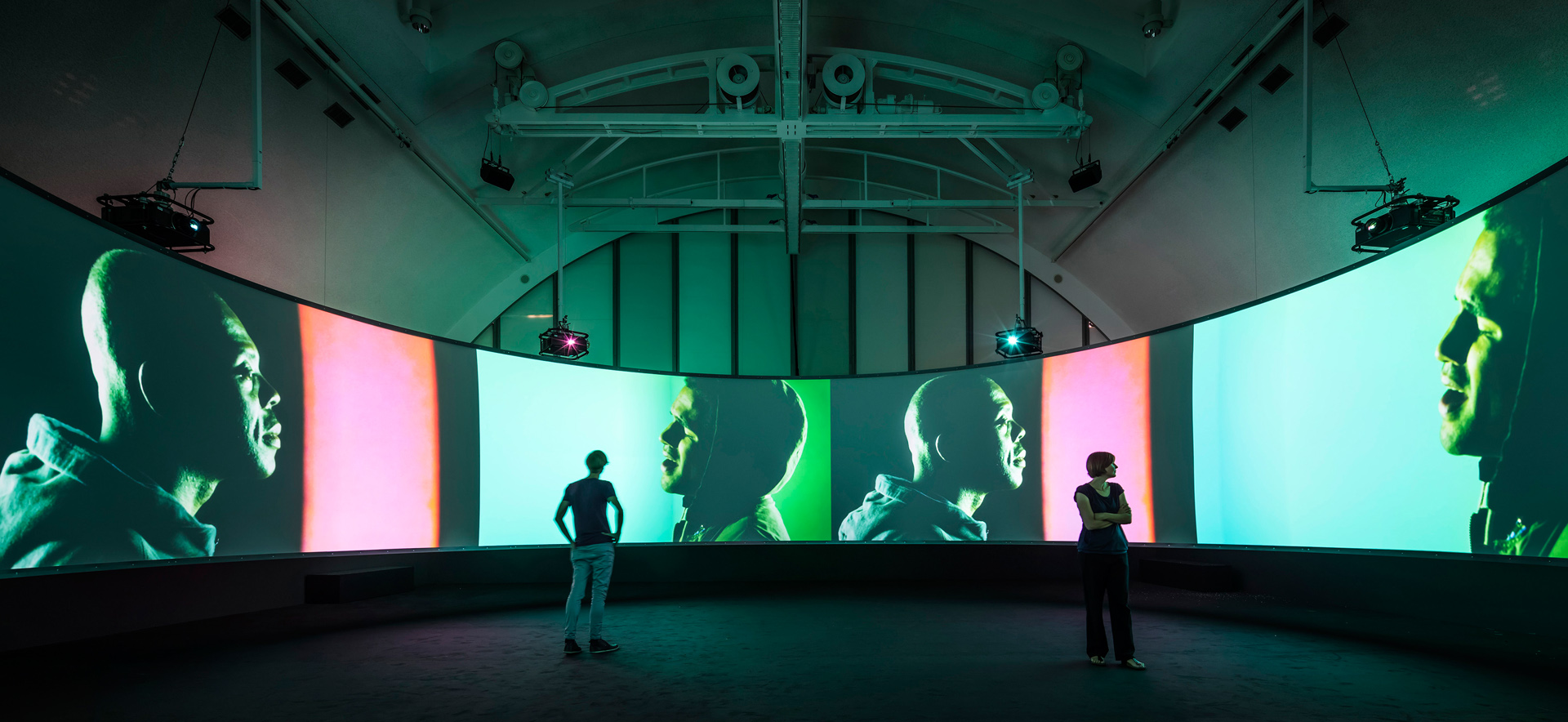
Doug Aitken’s Electric Earth is a multi-room, multi-screen video installation that immerses the viewer in a loosely structured narrative about a young man in a big city. Walking along the deserted outskirts of Los Angeles at night, the protagonist seems overwhelmed, emotionally and physically, by the everyday sights he encounters—a blinking streetlight, a wheel spinning on a shopping cart, the motions of a bill stuck in the slot of a soda machine, a car window, flickering fluorescent lights, and airplanes flying overhead. His own body mimics the motions and rhythms of these events—“I absorb that energy,” he remarks, “I eat it.” The feeling of being subsumed by this “electric earth” is reinforced by the enveloping, near-hypnotic nature of the installation itself, which surrounds the viewer with synchronized, large-scale video images. Electric Earth is characterized by the high production values and tight editing of Hollywood features, but it is also extremely poetic, drawing on the tools of the commercial film and video industry to create a haunting picture of preoccupation and alienation in contemporary society.
Author: kyungmookkim
Him & Her (Candice Breitz)
Doug Aiken
Keyword & Question
- What is ‘Expanded Cinema’?
- Screen-based Moving Image: Cinema of Exhibition, Post Cinema, Cinematic Video Installation
- Background: How the development of digital technology has enabled the expanded cinema in gallery and outside the movie theater
- With Interest in variable forms of cinematic experience
- Cinematic Experience: Spatialization and Temporalization
- How to create a story/narrative through time and space
- Traditional Cinema VS Expanded Cinema
Witness (2019, work in progress)
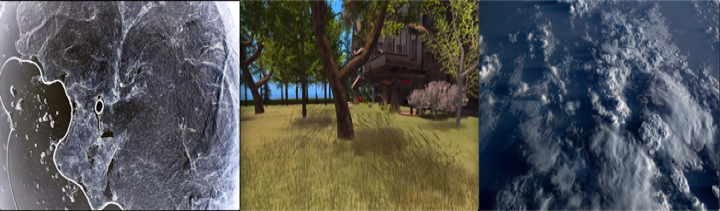
2019 | Video | Loop | Three Channel Installation
TV monitors, microscope, telescope, raspberry pi
‘Witness’ (work in progress) is a continuation work of Machine Meditation.
This work deals with how machines perceive and recreate the world through the lens of their own eyes.
Artist Statement
The machine records the world; it is a witness to the world.
The machine recreates the image of the world; it is the creator of the world.
The machine expands the human vision; it is an expansion of human eyes.
How the images of the world are recorded, recreated and expanded through the lens of the machine.
Machine Meditation (2018)
2018 | DV&16mm film | Seamless Loop | Multi Channel Installation
‘Machine Meditation’ is the first video installation work I made during the first semester in 2018. With typical objects found in a Buddhist temple, like incense and sitting cushions, the space resembles a religious temple. In this space, computer monitors take the place of religious statues. Through this video installation, I address my belief that machines have their own consciousness.


Preview Exhibition Expanded Cinema
MANIFESTO (Julian Rosefeldt)
Single Channel Film Version (Trailer)
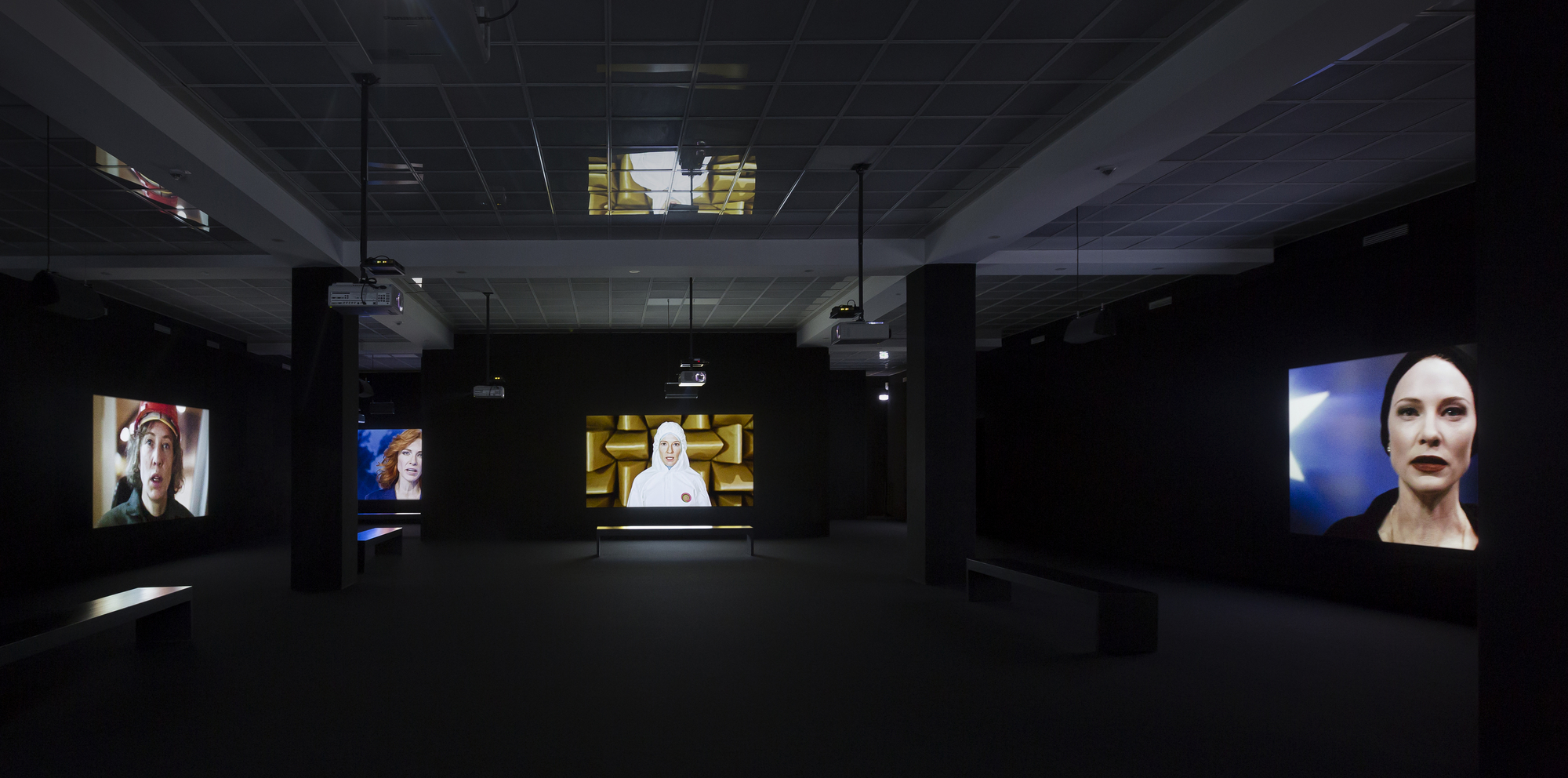
Manifesto (2015) ) directed by Julian Rosefeldt pays homage to artist manifestos, ultimately questioning the role of the artist in society today. It features Cate Blanchett in 13 different roles performing various manifestos. The film was shot over 12 days in 2014 in locations in and around Berlin. The film premiered and screened at the Australian Centre for the Moving Image in 2015. A 90-minute feature version premiered at the Sundance Film Festival in 2017.
The 13-channel Video Installation in Gallery

Ten Thousand Waves (Isaac Julien)
References
https://monoskop.org/Expanded_cinema
“‘Expanded cinema’ is an elastic name for many sorts of film and projection event. It is notoriously difficult to pin down or define. At full stretch, it embraces the most contradictory dimensions of film and video art, from the vividly spectacular to the starkly materialist. Stan VanDerBeek‘s synthetic multimedia Movie-Drome of the 1960s, for example, is in high contrast to the analytic and primal cinema of 1970s Filmaktion screenings in the UK. Some kinds of expanded cinema widen the field of vision so far that they dissolve cinema itself as a separate entity, merging it into cybernetic space, as envisaged in Gene Youngblood’s seminal book of 1970 or in Carolee Schneemann’s manifesto-like performance scripts of the same era. Other variants seek film’s ontology in the medium’s simplest elements, such as the projector lightbeam or the bare bulb. In ‘paracinema’, the notion of the film medium is itself questioned, and the cinematic is sought outside or beyond the film machine.” (Rees et al 2011: 12)
Filmmakers, artists[edit]
- Yann Beauvais
- Tony Conrad
- Gill Eatherley
- Filmaktion (Le Grice, Raban, Eatherley, Nicolson)
- B+W Hein
- Tony Hill
- Ken Jacobs
- Jeff Keen
- KwieKulik
- Malcolm Le Grice
- Maurice Lemaître
- Anthony McCall
- Werner Nekes
- Annabel Nicolson
- Hélio Oiticica
- William Raban
- Joost Rekveld
- Lis Rhodes
- Hans Scheugl
- Ernst Schmidt Jr.
- Carolee Schneemann
- Paul Sharits
- Michael Snow
- José Val Del Omar
- Valie Export
- Stan VanDerBeek
- Peter Weibel
- Robert Whitman
 Expanded Cinema